Strategy
Learning Management System vs. Training Software: Key Differences
05. 07. 2026
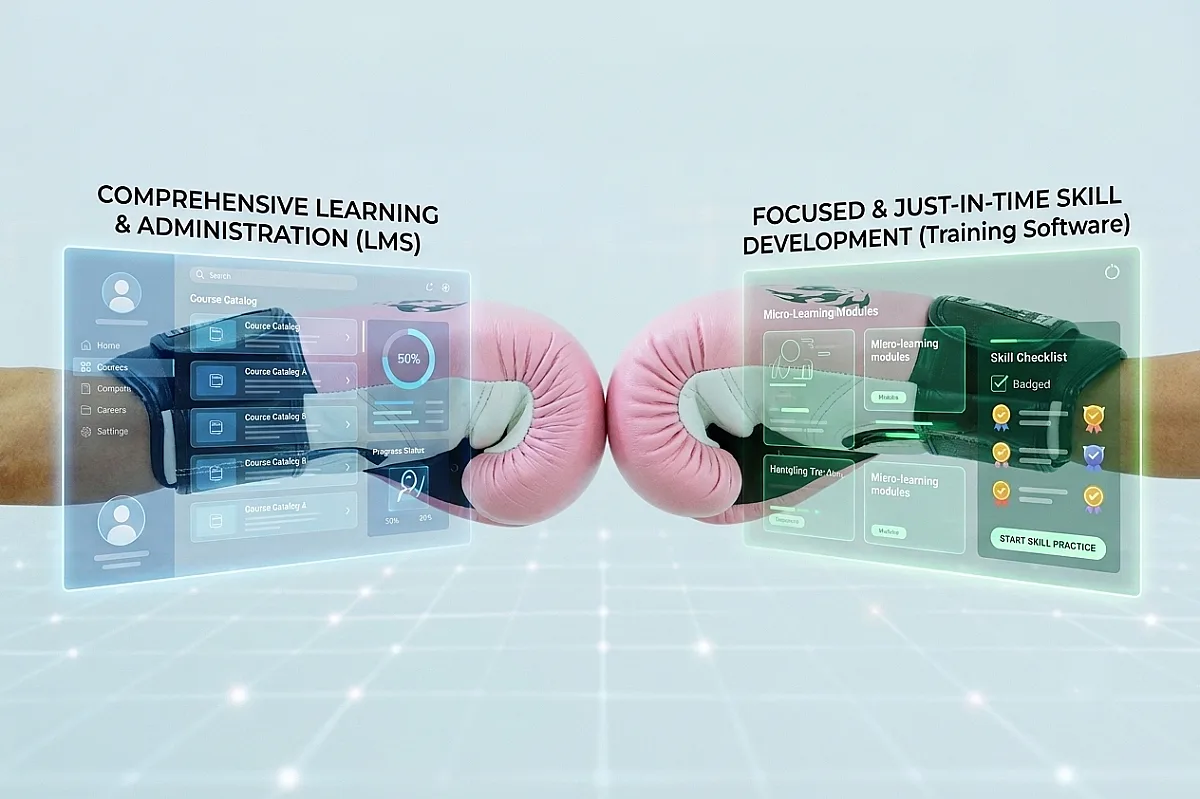
"Training software" and "LMS" get used interchangeably, and vendors are happy to keep it that way - it lets a video library call itself a learning platform and a quiz app call itself an LMS.
But the difference is real, it's expensive to get wrong, and it comes down to one question most buyers never ask.
Not "can it deliver training?" Almost everything can deliver training. The question is: can it prove what happened?
The category, untangled
"Training software" is an umbrella covering at least five distinct tools, each solving a different slice of the problem:
Authoring tools create course content - interactive slides, videos, quizzes - typically exported as SCORM packages. They produce training; they don't manage it. No assignment logic, no tracking across an organization, no records. An authoring tool without a delivery system is a factory without a warehouse.
Content libraries and course marketplaces sell ready-made courses on generic topics: soft skills, office software, standard compliance themes. Useful for individual upskilling; structurally incapable of covering your internal processes, your products, or your country's specific legal training requirements.
Video and knowledge platforms host content people can watch or read. "We have training" often means "we have a folder of videos." Consumption is optional, unverified, and unrecorded.
SOP and documentation tools are searchable manuals of "how we do things" - genuinely useful for operations, sometimes marketed as training platforms. But an employee having access to a process document is not an employee trained on it. The gap between the two is exactly what an auditor probes.
A learning management system is the layer that turns all of the above into an operation: it assigns training to the right people based on role or department, enforces deadlines, tests understanding, issues certificates, tracks validity, sends reminders, and records everything with timestamps. Content is an input. Management is the product.
The dividing line: the evidence test
Here's the practical test that separates the categories, and it takes ten seconds.
Ask the tool: show me everyone in role X who was required to complete training Y, whether they completed it, when, with what test result, and whether their certification is still valid.
An LMS answers with a report. Training software answers with silence - because delivering content and operating a training obligation are different jobs. The folder of videos doesn't know who was supposed to watch them. The authoring tool doesn't know the course was ever assigned. The SOP wiki doesn't know whether anyone understood what they read.
This distinction is invisible right up until it isn't: at an audit, an inspection, a client's supplier review, or - worst case - an incident investigation where the company's defense rests on demonstrating that the employee was properly trained. At that moment, "we sent everyone the video" has the legal weight of nothing.
When training software alone is enough
Being honest about the boundary: plenty of companies don't need an LMS, and buying one would be overhead.
If your training is voluntary upskilling with no compliance dimension, if nobody will ever ask you to prove completion, if your headcount is small enough that one person genuinely knows who learned what - a content library or a well-organized knowledge base does the job. The LMS category earns its cost when three conditions start appearing: obligations (training someone must complete), scale (too many people to track by memory), and accountability (someone external - regulator, auditor, client - can ask for proof).
Most growing companies cross all three thresholds earlier than they notice. Usually the moment of discovery is an audit announcement.
The modern complication: categories are merging
The clean separation above is dissolving from both directions, which makes buying harder.
Training software is adding LMS-ish features - completion checkmarks, basic quizzes - that look like management but don't survive scrutiny. A checkmark without role-based assignment logic, validity tracking, and an audit trail is decoration.
Meanwhile, modern LMS platforms have absorbed the authoring layer. AI-based course generation means the LMS no longer waits for content to be produced elsewhere: upload a policy document or a slide deck and the system builds the structured course and the test itself. This collapsed the historical reason to buy an authoring tool and an LMS separately — and made "we already have content in SCORM" a migration detail rather than a constraint, since a serious LMS imports those packages and runs them as first-class courses.
The practical consequence: don't evaluate by category label. Evaluate by the evidence test, and by whether content creation is built in or an extra purchase.
The layer nobody's comparison chart shows
There's a third level beyond both categories, and it matters most for mandatory training.
Delivering a legally required course - health and safety, fire protection, professional driver training - isn't just a content problem. The content must be correct under current national legislation, maintained by a qualified expert guarantor, updated when the law changes, and backed by valid certification. A global content marketplace can't provide this for your jurisdiction. A generic LMS can host it but takes no responsibility for it.
The most complete solutions bundle the platform with legally guaranteed course content and the surrounding compliance operations - documentation, validity management, and in some cases even the physical-world obligations (workplace inspections, equipment checks) that training records connect to. At that point the comparison isn't "LMS vs. training software" anymore. It's software vs. an operated compliance system.
Where Elevia fits
Elevia sits deliberately across all three layers, because in practice companies need all three at once.
It's the management system: role-based assignment, testing, certificates with validity tracking, email and SMS reminders, manager dashboards, audit logs, and HR system synchronization. It's also the authoring layer: Magic Import turns existing PPTX, PDF, DOCX, and SCORM materials into structured courses, generates tests automatically, and produces audio versions - with AI applied per course, never forced.
And it's built for the compliance layer: mandatory training with expert-validated content runs as first-class courses - imported exactly as approved, never rewritten by AI - with the platform handling what jurisdiction-specific content can't handle itself: assignment by role, testing, certificates, validity tracking, renewal reminders, and an audit trail that stands up when someone asks for proof.
So when you're comparing tools, run the evidence test first - it eliminates half the market in ten seconds. Then ask whether the platform creates content or expects you to. And if mandatory training is part of your reality, ask the question that separates software from a solution: who guarantees this content is legally current, and can the system prove it was completed?