Strategy
What Is an AI-Powered Learning Management System and How Does It Work?
23. 06. 2026
Most companies don't have a learning problem. They have a training administration problem.
HR teams are expected to onboard people faster, prove compliance, deliver mandatory training, keep records clean, and somehow get employees to actually complete their courses. In many companies, this still runs on a mixture of PDFs, PowerPoint decks, spreadsheets, email reminders, shared folders, and an LMS designed for a different decade.
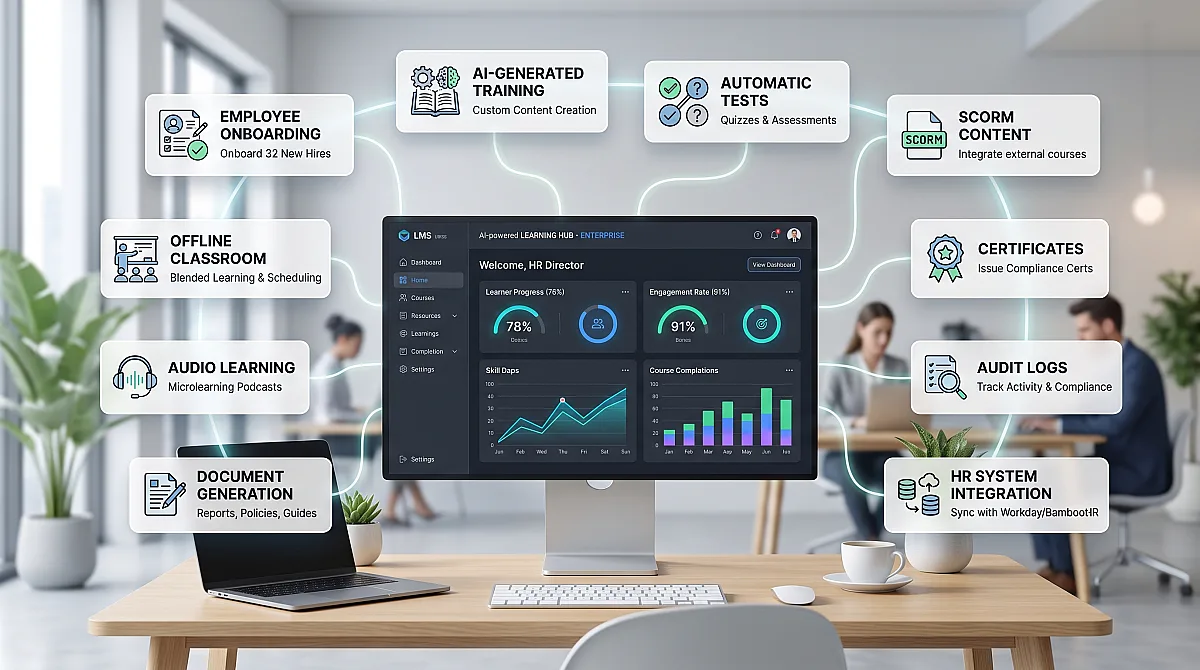
An AI-powered LMS changes the logic. It isn't just a place to upload courses - it helps create training, deliver it, test knowledge, issue certificates, send reminders, connect learning with onboarding, and generate the evidence HR needs when someone asks: who completed what, when, and with what result?
That's the difference between a passive archive and an active HR tool.
The definition
An AI-powered learning management system uses artificial intelligence to make corporate training faster to create, easier to manage, and easier to prove.
A traditional LMS stores courses and tracks completion. Useful, but limited - it assumes someone has already built the course, written the test, assigned the right people, sent the reminders, and archived the evidence. All of that work stays manual.
An AI-powered LMS takes over much of that chain. It turns existing materials into structured learning, generates tests automatically, supports multiple formats - text, audio, documents, SCORM packages, even offline classroom sessions - and connects with HR systems so training isn't managed separately from the employee lifecycle.
Put simply: it should reduce manual HR work, not just make the training screen look nicer.
How it works
The process typically runs in six steps.
1. You upload or create content. A PDF, presentation, internal policy, safety manual, onboarding checklist, product documentation, or an existing SCORM package.
2. The system structures it. Instead of HR manually rebuilding a 60-page document into a course, AI divides the material into logical sections, rewrites dense passages into clearer language, creates modules, and generates summaries.
3. It creates the assessment. This is where AI earns its keep. A modern LMS shouldn't require days of quiz-writing - it generates test questions directly from the training content and verifies that employees actually understood the material.
4. It delivers training to the right people. Assignment can follow department, role, location, seniority, risk exposure, or onboarding stage.
5. It tracks everything. Completion, test results, certificates, attendance, deadlines, and audit logs - in one place.
6. It creates evidence. In corporate training, especially compliance, "we sent them the document" is not enough. The company needs to prove what was assigned, who completed it, when, with what score, and whether the record exists.
Why traditional platforms fall short
Many LMS platforms were built more than a decade ago. Since then, HR changed, compliance changed, employee expectations changed, and AI changed what's possible. The platforms mostly didn't - they added features, layers, and settings, but underneath they still behave like content libraries.
HR managers don't need another complicated admin panel. They need a system that answers practical questions: Has this employee completed the required training? Are certificates valid? Who needs a reminder? Can we prove completion during an audit? Can we onboard 50 people without sending 200 manual emails? Can people use it without weeks of training?
If the answer is no, the LMS isn't supporting HR. HR is supporting the LMS.
What actually makes an AI LMS useful
Course generation alone isn't the value - that's becoming a commodity. The value is in combining content, process, automation, and evidence. For HR teams, it comes down to six things:
Faster training creation. The knowledge already exists in your company - it's just trapped in documents, presentations, and old SCORM courses. An AI LMS converts it into structured training without instructional designers or production teams that HR rarely has.
Automatic tests and certificates. Training without verification is weak. Auto-generated tests move you from "we gave them the material" to "we verified understanding," and certificates create a clean record for the employee, the manager, and the auditor.
Audio learning. Not everyone wants to read long materials on a screen. Audio lets employees learn during travel, between shifts, or wherever reading isn't practical - and for mandatory, repetitive topics it makes training feel less like punishment and more like something people actually finish.
SCORM support. Companies have invested in SCORM content, and a modern platform shouldn't force them to throw that away. The goal isn't choosing between old content and new workflows - it's bringing both into one system.
Offline training management. Fire safety, first aid, equipment training, and classroom workshops happen in person. A serious LMS handles them too: attendance, trainers, venues, certificates, and evidence belong in the same system as the e-learning, not in a separate spreadsheet.
HR system integration. When a new employee joins, HR shouldn't recreate the same process in five systems. The employee's role should define what happens next - automatically.
Onboarding: where an LMS becomes an operating system
Onboarding shows most clearly why a modern LMS has to be more than a course library.
A new engineering specialist doesn't need "general onboarding." They need role-specific training, company policies, compliance modules, safety instructions, technical documentation, and documents to acknowledge or sign. In a traditional setup, HR coordinates all of this through email - attaching PDFs, chasing managers for materials, tracking completion by hand, for days or weeks per hire.
In a modern AI-powered LMS, the process is structured around the role. HR creates or imports the employee, connects them to a position, and that position already carries its learning requirements, documents, tests, certificates, and deadlines. The system guides the employee through automatically, reminds them, tracks progress, and shows HR exactly what's done and what's missing.
That's the moment an LMS stops being a training platform and becomes part of the HR operating system.
The overlooked piece: documentation
Many HR processes are slowed down not by training, but by documents - acknowledgements, internal forms, onboarding confirmations, policy acceptances, compliance records.
That's why document generation belongs inside a modern learning platform. At Elevia, we built a simple macro-based document generator into the system, because most companies don't need another heavyweight document management system. They need a practical way to generate predefined documents from structured employee data.
Onboarding isn't finished when someone watches a video. It's finished when the person is trained, informed, documented, tested, and ready to work.
What decision makers should actually ask
"Does it have AI?" is too weak a question. Ask sharper ones:
- Can it turn existing documents into usable training and generate tests automatically?
- Does it support SCORM and manage offline training alongside online learning?
- Can it assign training by role, department, or location - and support onboarding, not just courses?
- Does it produce audit logs and proof of completion?
- Can it connect to our HR system?
- Can HR use it without technical frustration, and can employees understand it without instructions?
- Will it scale as we grow?
AI is only valuable if it removes work, reduces confusion, and improves control. Otherwise it's just a feature label.
Our view: the LMS market needs a reset
The LMS market is full of old systems with new paint - platforms designed when uploading a course and tracking completion was enough, with compliance, onboarding, integrations, analytics, and AI bolted on afterwards. The result is often heavy, ugly, and difficult to use.
Our team had built learning systems before Elevia, and we watched LMS projects become too personal, too fragmented, too dependent on individual customer preferences. Customers knew what frustrated them, but rarely how the whole system should be structured. So we stopped building one-off systems with no product logic behind them, and built Elevia instead: a focused product that listens to real HR feedback and develops fast.
For us, a customer with a strong opinion is valuable. Feedback shows exactly where the operational friction is - and that's where the product should improve.
What HR teams notice first
In enterprise conversations, the first reaction usually isn't about AI. AI matters, automation matters, SCORM and audit logs matter. But HR teams notice something more basic first: simplicity.
In a presentation for a large retail organization with more than 8,000 users, the strongest reaction from HR executives wasn't about any technical feature. It was that they finally saw something from the LMS world that felt simple, user-friendly, and good-looking.
That shouldn't be rare. In this market, it still is.
A modern LMS must be powerful enough for enterprise requirements and simple enough for daily HR work. If only the vendor understands the system, the system has failed.
So what is an AI-powered LMS, really?
It's not a system that writes training content. It's a platform that turns knowledge into action: documents become learning, tests get generated, completion gets tracked, online and offline training live in one place, learning connects to onboarding and documentation, and evidence exists by default.
Not another archive. Not another old system with an AI layer. Not another platform that creates more work for HR.
Where Elevia fits
Elevia is an AI-powered LMS built for companies that want to modernize training, onboarding, and compliance without adding complexity. It transforms existing materials into interactive training, tests, and audio learning, and supports SCORM, offline training management, certificates, reminders, audit evidence, HR integrations, SSO, and enterprise workflows.
If your current LMS feels more like an archive than an active HR tool, it's worth comparing it with what a modern system can do.
Book a demo of Elevia and see how onboarding, training, documentation, and compliance work when they're connected in one system.
Our view: the LMS market needs a reset
The LMS market is full of old systems with new paint - platforms designed when uploading a course and tracking completion was enough, with compliance, onboarding, integrations, analytics, and AI bolted on afterwards. The result is often heavy, ugly, and difficult to use.
Our team had built learning systems before Elevia, and we watched LMS projects become too personal, too fragmented, too dependent on individual customer preferences. Customers knew what frustrated them, but rarely how the whole system should be structured. So we stopped building one-off systems with no product logic behind them, and built Elevia instead: a focused product that listens to real HR feedback and develops fast.
For us, a customer with a strong opinion is valuable. Feedback shows exactly where the operational friction is - and that's where the product should improve.
What HR teams notice first
In enterprise conversations, the first reaction usually isn't about AI. AI matters, automation matters, SCORM and audit logs matter. But HR teams notice something more basic first: simplicity.
In a presentation for a large retail organization with more than 8,000 users, the strongest reaction from HR executives wasn't about any technical feature. It was that they finally saw something from the LMS world that felt simple, user-friendly, and good-looking.
That shouldn't be rare. In this market, it still is.
A modern LMS must be powerful enough for enterprise requirements and simple enough for daily HR work. If only the vendor understands the system, the system has failed.
So what is an AI-powered LMS, really?
It's not a system that writes training content. It's a platform that turns knowledge into action: documents become learning, tests get generated, completion gets tracked, online and offline training live in one place, learning connects to onboarding and documentation, and evidence exists by default.
Not another archive. Not another old system with an AI layer. Not another platform that creates more work for HR.
Where Elevia fits
Elevia is an AI-powered LMS built for companies that want to modernize training, onboarding, and compliance without adding complexity. It transforms existing materials into interactive training, tests, and audio learning, and supports SCORM, offline training management, certificates, reminders, audit evidence, HR integrations, SSO, and enterprise workflows.
If your current LMS feels more like an archive than an active HR tool, it's worth comparing it with what a modern system can do.
Book a demo of Elevia and see how onboarding, training, documentation, and compliance work when they're connected in one system.