Strategy
What Happens If I Don't Use AI in My Learning Management System?
03. 07. 2026
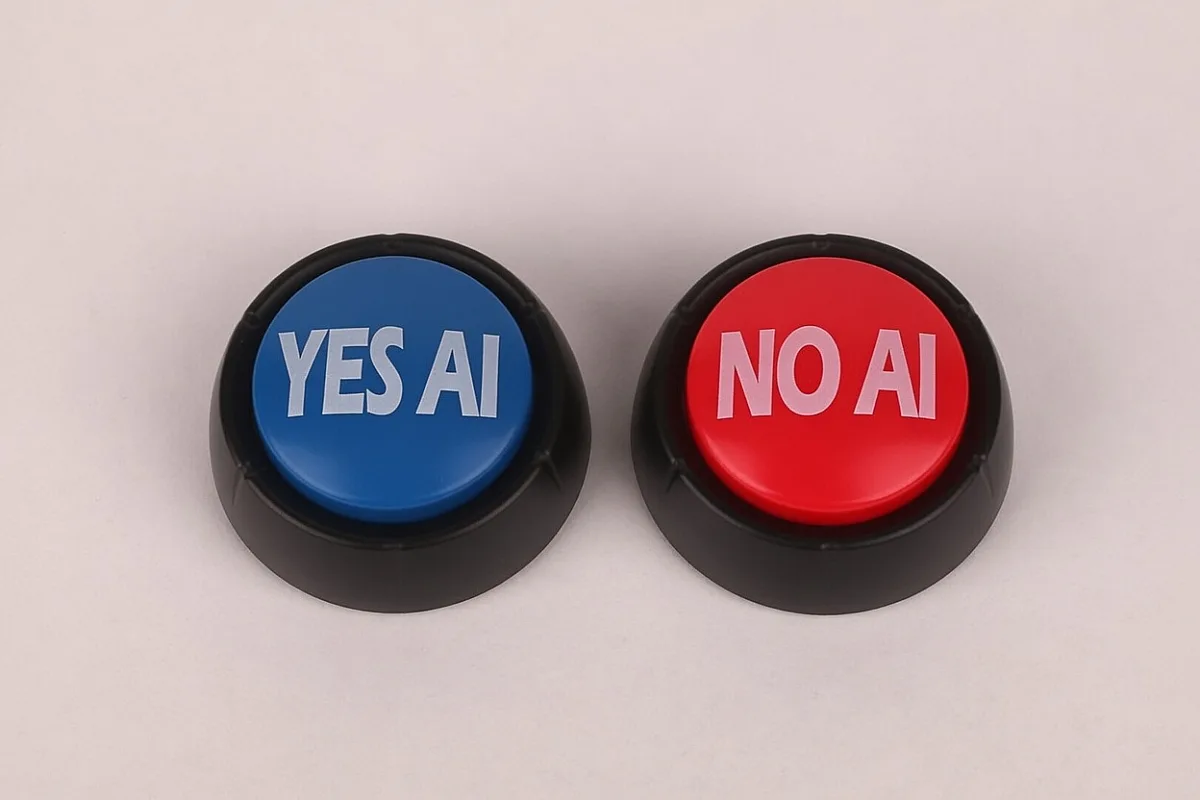
Honestly? Less than the hype suggests.
That's an unusual thing to hear from an AI-powered LMS vendor, so let's be precise about it. AI in corporate learning is a speed layer, not a requirement. Companies ran structured, compliant, effective training programs for decades without it. If you switch AI off tomorrow, your training doesn't stop working - you just pay for it differently.
The real question isn't whether you need AI. It's whether you understand what you're trading, and whether your LMS forces the choice on you at all.
What you don't lose without AI
Control and quality. A course written by your safety engineer or compliance officer, by hand, is not a lesser course. For some content it's the better one. Expert-authored training carries nuance and institutional knowledge that no generated draft will match on the first pass.
Your existing content investment. If your company has years of e-learning built in SCORM, that content doesn't expire because AI arrived. A capable LMS imports your SCORM packages and runs them alongside everything else - same assignments, same tracking, same certificates, same audit trail. The content format is irrelevant to the compliance record.
Certified and legislative content. Some training must be delivered exactly as validated - health and safety modules approved by an authorized provider, legally mandated content, externally certified programs. This material shouldn't be AI-rewritten at all. Regenerating validated content isn't efficiency; it's re-opening a closed approval.
The evidence chain. Completion tracking, testing, certificates, reminders, and audit records have nothing to do with how the content was authored. A manually built course produces exactly the same proof as a generated one.
What you actually pay
The cost of skipping AI is measured in one currency: time. And it compounds.
First-draft time. Converting a 40-page directive into a structured course by hand takes days. With AI it takes a review session. Skip AI and you pay the difference on every new course - and every update.
Test creation. Writing twenty good questions with plausible distractors is the most hated task in L&D for a reason. Done manually, it's days per course. This is the single place where skipping AI hurts most, because the work is repetitive and the quality of hand-made tests tends to degrade as fatigue sets in.
Update velocity. Without AI, content updates inherit the production cycle. A changed parameter in a product sheet or a revised paragraph in a policy waits for someone to have time. Outdated training isn't a dramatic failure - it's a slow one, which makes it easy to ignore.
Scale. At five courses a year, manual authoring is a preference. At fifty courses across roles, locations, and languages, it's a headcount decision. The time tax doesn't grow linearly with company size; the number of things to maintain does.
None of this is fatal. All of it is a real, recurring operating cost that stays invisible because it's distributed across many people in small increments.
The question nobody asks vendors: is AI optional?
The market has split into two dogmas. Legacy platforms have no meaningful AI, so manual production is your only option. Newer AI-first tools push generation into everything, treat imported content as a second-class citizen, and quietly assume you'll rebuild your library their way.
Both extremes force a choice you shouldn't have to make. The sensible architecture treats AI as an accelerator you apply per course, not a mode you commit to:
- New internal training from a raw document? Generate the draft, review, publish.
- A validated SCORM package from your certified provider? Import it untouched and track it like everything else.
- An expert-written course your specialist insists on authoring manually? Build it in the editor, no AI involved.
- And the combination nobody talks about: an old SCORM course that works fine but has a weak test — or none at all. Keep the content exactly as it is, and let AI generate just the test on top of it. Ten minutes instead of an afternoon, and a legacy course suddenly produces verifiable results.
One system, one training record, one audit trail - regardless of how each course came into existence. The moment "AI or not" determines which system a course lives in, you've recreated the spreadsheet problem with extra steps.
So what actually happens if you don't use AI?
Your training still runs. Your compliance still holds. Your experts stay in control.
You'll spend more hours on course production and test writing than your competitors do, and the gap will widen as you grow - that's the honest trade. But the worst outcome isn't skipping AI. It's choosing a platform where the decision is made for you: either an old system that can't accelerate anything, or an AI-first tool that can't respect the content you already own.
Where Elevia fits
Elevia doesn't require AI to be useful. You can author courses manually in the editor, import existing SCORM packages and run them as first-class content, and bring in certified legislative training exactly as validated - with full tracking, testing, certificates, and audit evidence across all of it.
AI sits on top as an option, per course: generate a draft from a document when speed matters, add an AI-generated test to an imported SCORM course you don't want to touch, or use none of it. The system doesn't care how the content was made. It cares that the training was completed, verified, and provable.
Use AI where it saves you days. Skip it where your experts or your regulator say so. The platform should support both - because your training operation includes both.