Strategy
AI Learning Management System for Corporate Training: A Practical Buyer’s Guide
14. 07. 2026
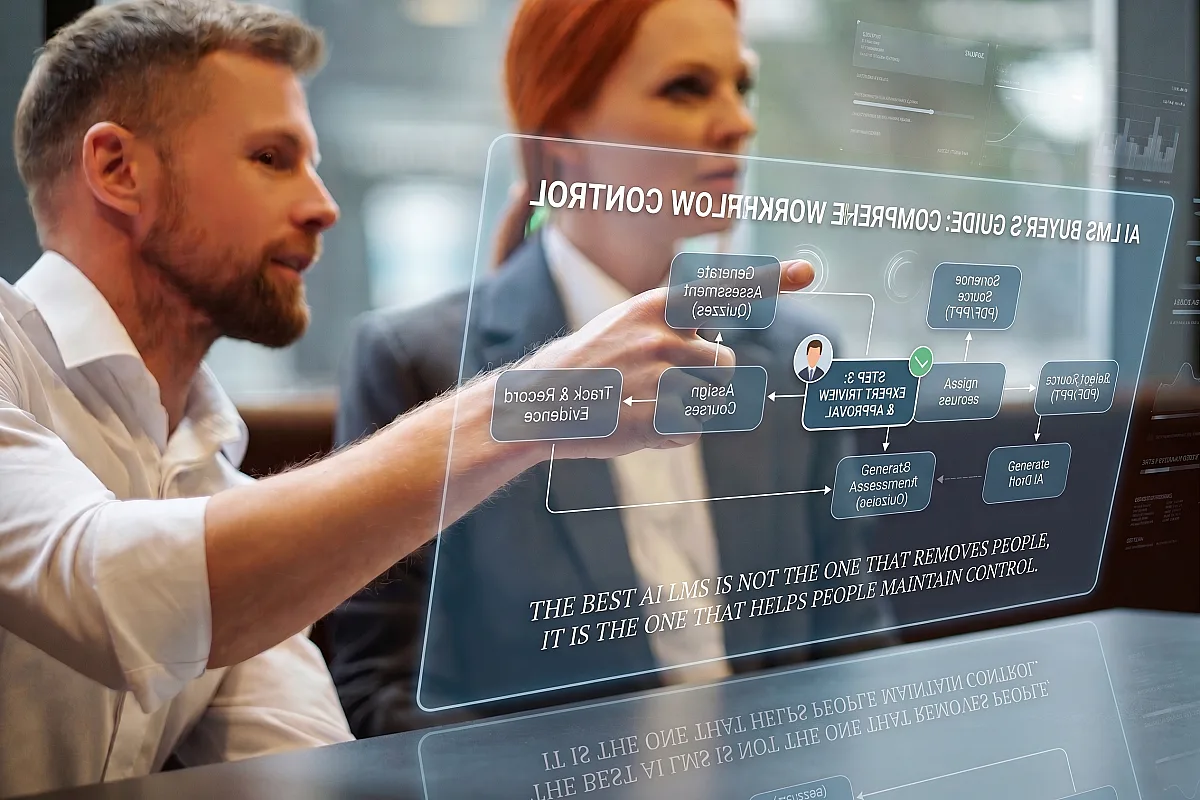
Artificial intelligence is becoming a standard feature in learning management systems.
But the phrase “AI-powered LMS” can mean almost anything.
For one vendor, it may mean a chatbot added to an existing platform. For another, it may mean automatic quiz generation. Some systems focus on recommendations and personalised learning. Others use AI to turn documents into complete training courses.
That makes comparison difficult.
A company choosing an AI learning management system for corporate training should not begin by asking:
“Does this LMS have AI?”
The better question is:
“What useful work does the AI actually remove from our training process?”
Corporate training involves much more than producing attractive course content.
Companies need to:
- identify who needs training,
- prepare and approve the material,
- assign the correct courses,
- send reminders,
- test knowledge,
- issue certificates,
- maintain records,
- update content,
- and provide evidence during audits or inspections.
AI can accelerate several parts of this process.
But it should work inside a controlled learning-management workflow, not as an isolated content generator.
This guide explains what an AI learning management system should do for corporate training, where AI creates practical value, which risks companies should manage and what buyers should ask before selecting a platform.
What Is an AI Learning Management System?
An AI learning management system is an LMS that uses artificial intelligence to assist with learning-content creation, administration, analysis or delivery.
A traditional LMS normally allows companies to:
- upload courses,
- assign them to users,
- track completion,
- manage tests,
- issue certificates,
- and produce reports.
An AI-enabled LMS adds functions that can reduce repetitive manual work.
Depending on the platform, AI may help:
- analyse source documents,
- create course structures,
- rewrite complex content,
- generate summaries,
- prepare quiz questions,
- suggest answer options,
- create audio versions,
- translate content,
- identify learning gaps,
- recommend courses,
- or assist users during learning.
However, the presence of AI does not automatically make an LMS suitable for corporate training.
The system must still handle the operational requirements of the organisation.
It needs to connect content creation with assignment, tracking, assessment, certification and reliable records.
For a basic explanation of the category, read What Is an AI-Powered Learning Management System and How Does It Work?.
AI Course Creation Is Not the Same as an AI LMS
This is one of the most important distinctions for buyers.
An AI course generator may produce:
- lessons,
- slides,
- summaries,
- images,
- questions,
- and narration.
That can be useful.
But once the course is created, the organisation still needs to manage it.
Someone must decide:
- who should complete it,
- by what date,
- which version is valid,
- what score is required,
- whether a certificate should be issued,
- what happens when the deadline is missed,
- when retraining is necessary,
- and where completion evidence is stored.
A course-creation tool produces content.
A learning management system manages the training process.
A complete AI LMS should connect both.
This is also the difference between a content tool and operational training software. We examine it further in Learning Management System vs Training Software: Key Differences.
Where AI Creates the Most Value in Corporate Training
AI is most valuable where companies already have knowledge but struggle to turn it into usable learning.
The information may already exist in:
- PDF documents,
- PowerPoint presentations,
- Word files,
- internal policies,
- process manuals,
- product documentation,
- safety instructions,
- onboarding materials,
- or archived courses.
The problem is usually not a lack of information.
The problem is the manual effort required to transform it into training.
Structuring source materials
AI can analyse a long document and propose a logical course structure.
For example, a fifty-page internal policy may become:
- Course introduction
- Key responsibilities
- Common risks
- Required employee actions
- Practical examples
- Final assessment
This gives the responsible expert a structured first draft instead of a blank page.
Simplifying complex language
Policies and technical documents are often written for accuracy, not learning.
AI can help rewrite dense paragraphs into shorter, clearer explanations while preserving the central meaning.
The result must still be reviewed, especially when the source contains legal, safety, technical or compliance information.
Generating assessment questions
Creating useful questions manually takes time.
AI can prepare:
- multiple-choice questions,
- plausible incorrect answers,
- scenario-based assessments,
- explanations,
- and question variations.
The responsible expert can then review, edit and approve them.
This can reduce one of the most repetitive parts of course production. See Stop Wasting Days Generating Quiz Questions.
Preparing alternative formats
AI can help turn the same source material into:
- shorter lessons,
- executive summaries,
- audio scripts,
- knowledge recaps,
- role-specific versions,
- or translated drafts.
This can make existing knowledge easier to distribute across different teams and locations.
Updating existing training
When a source document changes, AI may help identify which parts of an existing course need revision.
Instead of rebuilding everything, the course owner can focus on the affected sections.
This supports a more agile approach to learning-content maintenance. Read more in Agile Course Creation vs the Traditional Three-Month Cycle.
Where AI Should Not Be in Control
Corporate training can affect employee safety, legal obligations, customer outcomes and regulated operations.
AI should therefore not be treated as the final authority.
It should not independently decide:
- what the law requires,
- which employees are legally required to complete a course,
- whether safety training is sufficient,
- whether certified content may be modified,
- whether an employee is competent to perform a practical task,
- whether a policy is legally correct,
- or whether an organisation has fulfilled its compliance duties.
The safest operating model is:
AI prepares.
Experts review and approve.
The LMS delivers, tracks and records.
The company remains responsible for the content, the training rules and the use of the final result.
Some training may also need to remain entirely outside AI-assisted authoring.
This may include:
- externally certified courses,
- validated SCORM packages,
- regulated content that must remain unchanged,
- or highly sensitive internal information.
A modern LMS should support both AI-assisted and conventional content.
AI should be an option where it provides value, not a compulsory layer applied to every course.
For a more detailed discussion, see What Happens If I Don’t Use AI in My Learning Management System?.
Important Corporate Training Use Cases
The value of an AI LMS becomes clearer when viewed through real company workflows.
Employee Onboarding
Onboarding often depends heavily on experienced employees.
A manager or senior colleague repeatedly explains:
- the company,
- internal processes,
- systems,
- customer expectations,
- product information,
- reporting rules,
- and role-specific responsibilities.
Some personal support will always be necessary.
But much of the repeatable information can be delivered consistently through an LMS.
AI can help transform existing onboarding documents and presentations into structured learning.
The LMS can then:
- assign the correct content,
- deliver it in a defined sequence,
- send reminders,
- verify knowledge,
- record completion,
- and show managers where support is still needed.
This allows experienced employees to focus more on coaching, feedback and practical integration.
Compliance and Mandatory Training
Compliance training requires more than sending a document.
The organisation may need to demonstrate:
- who was assigned the course,
- which content version was used,
- when the employee completed it,
- what score they achieved,
- whether a certificate was issued,
- and when retraining is due.
AI can help prepare or update the learning material.
But the LMS must manage:
- controlled publishing,
- employee assignment,
- deadlines,
- reminders,
- assessments,
- certificates,
- records,
- and audit evidence.
The responsible legal, safety or compliance expert must remain accountable for the content and requirements.
Product Training
Products change faster than traditional course-production cycles.
A new feature may launch, pricing may change or a sales process may be updated.
AI can help convert product documentation into short training modules and assessments.
The LMS can then assign the update to:
- sales teams,
- customer support,
- implementation teams,
- partners,
- or selected customer groups.
The organisation can see who completed the update and whether they understood the key changes.
Internal Process Training
Companies often document processes but fail to turn them into proper learning.
Employees receive:
- operating procedures,
- shared documents,
- process diagrams,
- email instructions,
- and long presentations.
AI can help structure these materials into courses.
The LMS can then ensure that the relevant people receive the correct process training, complete it and acknowledge updated instructions.
Cybersecurity Training
Cybersecurity content changes frequently and must be understandable to non-technical employees.
AI may help simplify technical material, create realistic scenarios and generate draft assessments.
The LMS can support:
- recurring training,
- role-based content,
- phishing-awareness modules,
- tests,
- completion records,
- and refresher campaigns.
However, the information-security owner should approve the final content and scenarios.
Knowledge Transfer
When experienced employees leave, companies often lose knowledge that was never structured.
AI can help transform:
- process notes,
- interviews,
- manuals,
- presentations,
- and internal documents
into reusable training.
This does not replace direct handover, but it can preserve more knowledge in a consistent and searchable format.
A Controlled AI Training Workflow
A responsible AI learning process can be structured into clear stages.
1. Select the source material
Use an approved document, policy, manual or presentation.
Confirm:
- who owns it,
- whether it is current,
- which employees it applies to,
- whether sensitive information should be removed,
- and whether AI processing is permitted.
2. Generate a course draft
AI prepares an initial structure, lessons, summaries and key points.
The purpose is to accelerate production, not publish automatically.
3. Review the content
A subject-matter expert checks:
- accuracy,
- completeness,
- terminology,
- practical relevance,
- legal or technical requirements,
- and suitability for the audience.
4. Generate and review the assessment
AI prepares questions and answer options.
The expert confirms that:
- only one answer is correct,
- questions test meaningful knowledge,
- scenarios reflect real work,
- and the pass threshold is appropriate.
5. Approve the final version
The organisation records:
- the approved content,
- the course owner,
- the version,
- and the review date.
6. Assign the course
The LMS assigns the course based on:
- role,
- department,
- location,
- employment status,
- onboarding stage,
- risk level,
- or another defined rule.
7. Automate reminders
Employees receive clear notifications about:
- the course,
- the deadline,
- expected duration,
- required result,
- and consequences of non-completion where relevant.
8. Track results
The system records:
- assignment,
- completion,
- test score,
- attempts,
- certificate,
- version,
- and timestamps.
9. Review and update
The course owner reviews the training when:
- the source material changes,
- the review date arrives,
- employee performance shows a knowledge gap,
- or the organisation changes its processes.
This end-to-end approach is covered in more detail in How to Automate Employee Training With AI Without Losing Control.
Features to Evaluate in an AI LMS
An impressive AI demonstration is not enough.
Buyers should evaluate the complete platform.
Document-to-course creation
Can the system use the company’s existing materials?
Look for support for relevant formats such as:
- PDF,
- Word,
- PowerPoint,
- presentations,
- manuals,
- and internal policies.
The output should be editable.
A platform that generates content but does not allow detailed human correction creates unnecessary risk.
Human review and approval
The responsible person should be able to:
- review the course,
- edit every part,
- adjust questions,
- approve the final version,
- and retain clear ownership.
The system should not treat AI output as automatically correct.
Manual course creation
Not every course should use AI.
The platform should allow users to create or edit content manually.
This is important for:
- expert-created courses,
- sensitive content,
- validated material,
- and highly specific training.
SCORM support
Many companies already own existing e-learning packages.
The LMS should allow organisations to upload SCORM content and use it as training without rebuilding it.
Buyers should also check what completion and result data the system can track from the package.
Assessments
Look beyond basic quiz generation.
The system should support:
- question editing,
- pass thresholds,
- multiple attempts,
- result tracking,
- question explanations,
- and practical or scenario-based assessments where appropriate.
Assignment rules
The LMS should deliver the correct course to the correct employee.
Useful assignment criteria may include:
- role,
- department,
- location,
- management status,
- onboarding stage,
- or employee group.
Reminders and recurring training
The platform should manage:
- initial notifications,
- upcoming deadlines,
- overdue reminders,
- certificate expiry,
- and recurring training.
Without this, HR may still need to manage the process manually.
Certificates and audit records
For many corporate use cases, the platform should record:
- employee identity,
- course,
- version,
- completion date,
- score,
- certificate,
- and relevant audit events.
Ask whether the evidence can be exported when required.
Offline and classroom training
Not all training can or should be completed online.
The LMS should allow companies to manage or record:
- classroom sessions,
- practical training,
- attendance,
- external certificates,
- and other offline activities.
This helps create one consistent training record.
HR-system integration
Integration can reduce duplicate administration.
When employee information changes in an HR system, the LMS may use it to update:
- user access,
- role,
- department,
- training assignments,
- or onboarding workflows.
The exact integration scope should be confirmed with the vendor.
Single sign-on
Microsoft or another single sign-on method can make access easier and reduce password administration.
Buyers should confirm:
- supported identity providers,
- implementation requirements,
- user-provisioning options,
- and any additional costs.
Reporting
Reporting should answer practical questions:
- Who has completed the required training?
- Who is overdue?
- Which teams have low completion?
- What results did employees achieve?
- Which certificates are expiring?
- Which training version was completed?
- Can evidence be exported?
A colourful dashboard is useful only if it supports operational decisions.
Questions to Ask Vendors
Before choosing an AI LMS, ask vendors to answer these questions clearly.
AI and content
- Which source formats can the AI process?
- Can every generated element be edited?
- Does the system publish content automatically?
- How is human approval handled?
- Can AI be disabled for selected courses?
- Can we use manual and SCORM content in the same platform?
- Can the system create tests from our approved materials?
- How are translations and audio versions handled?
Data and security
- Where is our data processed?
- Which subprocessors are involved?
- Is customer content used to train external models?
- Can sensitive information be excluded from AI processing?
- What retention rules apply?
- What contractual documentation is available?
Training operations
- Can courses be assigned by role or department?
- Are reminders automated?
- Can certificates be issued?
- Can recurring training be configured?
- Can offline training be recorded?
- Is there a reliable audit trail?
- Can we export completion evidence?
Integration
- Can the LMS connect with our HR system?
- Does it support Microsoft single sign-on?
- How are users created and updated?
- What implementation support is included?
- Are integrations included in the price?
Commercial terms
- What is included in the subscription?
- Is AI usage limited?
- Are telecommunications services charged separately?
- Are implementation and migration additional?
- What support level is included?
- What are the export and exit conditions?
- What will the platform cost over three years?
Common Buying Mistakes
Choosing AI instead of choosing a workflow
Companies sometimes select the platform with the most impressive generation demo.
But training success depends on what happens after generation.
The content must still be approved, assigned, completed, tested, recorded and updated.
Evaluate the complete workflow.
Assuming AI output is automatically accurate
Polished language can create false confidence.
AI-generated content may still:
- omit important details,
- misinterpret the source,
- oversimplify requirements,
- or generate ambiguous questions.
Human review remains necessary.
Replacing bad documents with bad courses
AI cannot solve an outdated or contradictory source document.
Before generating a course, confirm that the source is valid.
Otherwise, the organisation may simply distribute incorrect information more efficiently.
Automating too much too early
Begin with one or two controlled use cases.
For example:
- onboarding,
- cybersecurity,
- one recurring internal process,
- or one compliance course.
Test the workflow, approvals and reporting before scaling across the company.
Ignoring non-AI content
A corporate LMS may need to manage:
- manual courses,
- imported SCORM,
- external certificates,
- classroom sessions,
- practical assessments,
- and certified training.
An AI-only content strategy is too narrow for most organisations.
Ignoring ongoing ownership
Every important course needs:
- an owner,
- an approval process,
- a version,
- and a review date.
AI makes updates faster, but someone still needs to decide when an update is required.
How to Implement an AI LMS
A controlled implementation does not need to begin with the entire organisation.
Phase 1: Select one use case
Choose a process with clear value.
Good candidates include:
- recurring onboarding,
- one internal policy,
- one product-training process,
- cybersecurity awareness,
- or a frequently updated manual.
Phase 2: Prepare the source
Confirm:
- document ownership,
- approval status,
- version,
- target audience,
- and whether AI processing is appropriate.
Phase 3: Create and review the course
Generate the first draft.
Have the responsible expert review:
- content,
- examples,
- language,
- questions,
- and completion requirements.
Phase 4: Run a pilot
Assign the course to a small user group.
Observe:
- completion,
- user questions,
- test performance,
- technical issues,
- and administrative workload.
Phase 5: Adjust the workflow
Improve:
- lesson length,
- questions,
- reminders,
- assignment logic,
- reporting,
- and support materials.
Phase 6: Scale gradually
Once the process works, expand it to:
- additional departments,
- additional courses,
- more locations,
- or recurring training.
This is safer and more practical than attempting to automate every training process at once.
How to Measure Success
Do not evaluate an AI LMS only by the number of courses generated.
Useful measures may include:
- time required to produce a course,
- time required to update a course,
- HR administration time,
- number of manual reminders,
- completion rates,
- overdue training,
- assessment results,
- employee feedback,
- availability of audit evidence,
- and time needed to prepare reports.
The goal is not to generate more content.
The goal is to improve how corporate knowledge is created, delivered, verified and maintained.
How Elevia Approaches AI-Powered Corporate Training
Elevia connects AI-assisted course creation with the wider learning-management process.
Companies can use existing:
- PDF documents,
- Word files,
- PowerPoint presentations,
- policies,
- manuals,
- and internal materials
as the basis for structured courses.
AI can assist with:
- course structure,
- learning content,
- quiz questions,
- summaries,
- and audio learning.
The responsible expert can review and edit the output before publication.
Elevia then supports the operational process through:
- course assignments,
- tests,
- reminders,
- certificates,
- completion tracking,
- audit records,
- role-based onboarding,
- SCORM content,
- online and offline training,
- HR integrations,
- and Microsoft sign-in or single sign-on depending on implementation scope.
This means AI does not operate as a separate content experiment.
It works within a controlled training workflow.
The principle is straightforward:
AI accelerates preparation.
Experts retain control.
Elevia manages delivery, verification and evidence.
Final Thought
An AI learning management system should not be judged by how quickly it generates a course during a sales demonstration.
It should be judged by how well it supports the real work of corporate training.
Can it use your existing knowledge?
Can experts review and approve the output?
Can it assign the correct training?
Can it test understanding?
Can it send reminders?
Can it manage certificates and retraining?
Can it maintain evidence?
Can it support AI and non-AI content in one system?
Those questions matter more than whether the platform displays an AI badge.
The best AI LMS is not the one that removes people from the process.
It is the one that removes repetitive work while helping people maintain control.
Send us one existing training process, document or course.
We will show you how it can work inside Elevia using your own content, approval requirements and employee structure.
No generic demonstration.
Your knowledge.
Your rules.
Your training workflow.
Your rules.
Your training workflow.
Frequently Asked Questions
What is an AI learning management system for corporate training?
It is an LMS that uses artificial intelligence to assist with activities such as course creation, document analysis, quiz generation, summaries or content updates while also managing assignments, tracking, certificates and training records.
Can AI create corporate training from a PDF?
Yes. AI can analyse a PDF, propose a course structure, simplify content and generate draft assessment questions. The final course should still be reviewed and approved by a responsible expert.
Does an AI LMS replace HR or learning specialists?
No. AI can reduce repetitive production and administration work, but people remain responsible for training requirements, content accuracy, approval and employee support.
Can an AI LMS be used for compliance training?
It can support compliance-training creation, assignment, testing, reminders, certificates and records. However, legal requirements and final content should be confirmed by qualified internal or external experts.
Should every course use AI?
No. Companies may also need manually authored courses, SCORM packages, externally certified content, classroom training and practical assessments. A modern LMS should support all these formats.
What is the difference between an AI course generator and an AI LMS?
An AI course generator creates content. An AI LMS also manages users, assignments, deadlines, assessments, certificates, recurring training and completion evidence.
How should a company begin implementing an AI LMS?
Start with one controlled use case, use approved source material, require expert review, run a small pilot and measure both learning results and administrative effort before scaling.